- Real Balances Effect
- when price-level is high, households and businesses cannot afford to purchase as much output
- Interest Rate Effect
- a lower price-level decreases the interest rtate which tends ro encourage investment
- Foreign Purchases Effect
- a higher price-level increases the demand for relatively cheaper imports
- a lower price-level increases the foreign demand for relatively cheaper US exports
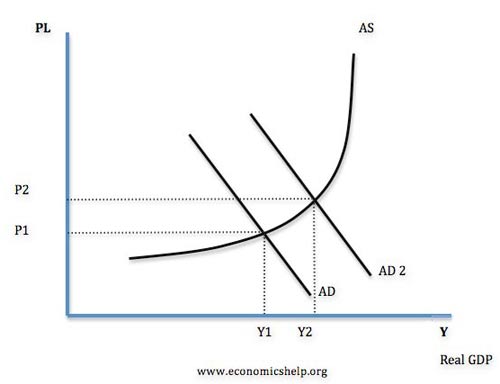 Shifts in Aggregate Demand (AD)
-a change in C, Ig, G, and/or Xn
-multiplier effect
-increase in AD, shift right
-decrease in AD, shift left
Consumption
Household spending is affected by:
- Consumer Wealth
- more wealth = more spending (AD shifts right)
- Less wealth = less spending (AD shifts left)
- Consumer Expectations
- positive expectatios = more spending (AD shifts right)
- negative expectations = less spending (shift left)
- Household Indebtness
- Less debt = more spending (shift right)
- More debt = less spending (shift left)
- Taxes
- Less taxes = more spending (AD shifts right)
- More taxes = less spending (AD shifts left)
Gross Private Investment
Investment Spending is sensitive to:
- The Real Interest Rate
- Lower Real Interest Rate = More Investment (AD shifts right)
- Higher Real Interest Rate = Less Investment (AD shifts left)
- Expected Returns
- Higher Expected Returns = More Investment (AD shifts right)
- Lower Expected Returns = Less Investment (AD shifts left)
- Expected returns influenced by:
- Expectations of future profitability
- Technology
- Degree of Excess Capacity (Existing Stock of Capital)
- Business Taxes
- More government Spending (AD shifts right)
- Less Government Spending (AD shifts left)
-sensitive to:
- Exchange Rates (International value of $)
- Strong $ = More Imports and Fewer Exports (AD shifts left)
- Weak $ = Fewer Imports and More Exports (AD shifts right)
- Relative Income
- Strong Foreign Economies = More Exports (AD shifts right)
- Weak Foreign Economies = Less Exports (AD shifts left)

No comments:
Post a Comment