Personality is an individual's characteristic pattern of thinking, feeling, and acting. The study of personality focuses on two broad areas: One is understanding individual differences in particular personality characteristics, such as sociability or irritability. The other is understanding how the various parts of a person come together as a whole.We will be looking at four different perspectives on personality: psychoanalytic, humanistic, trait, and social-cognitive.
Psychoanalytic Perspective
Freud often encountered patients suffering from nervous disorders in his clinical practices. Their complaints could not be explained in terms of purely physical causes. This led him to develop the first comprehensive theory of personality, which included the unconscious mind, psycho-sexual stages, and defense mechanisms.
Freud believed that personality develops throughout life and is not fixed in childhood. However, he under-emphasized peer influence on the individual which may be as powerful as parental influence. He also believed that gender identity may develop before 5-6 years of age, there may be other reasons for dreams besides wish fulfillment, and that verbal slips can be explained on the basis of cognitive processing of verbal choices. Freud said that suppressed sexuality leads to psychological disorders. His psychoanalytic theory rests on the repression of painful experiences into the unconscious mind.
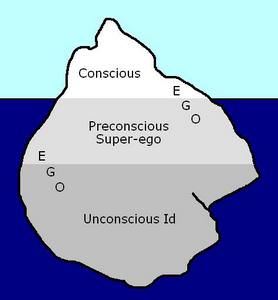 Model of the Mind
The mind is like an iceberg. It is mostly hidden, with the consciousness level being represented by the tip of the iceberg.
- Below the surface lies the preconscious mind, which stores temporary memories and stored knowledge.
- The unconscious mind is deep below the surface, storing mostly unacceptable thoughts, wishes, feelings, and memories. Once these memories are retrieved and released (through psychoanalysis), the patient feels better.
Freud classified three elements that make up personality: the id, ego, and superego.
-
Id: The Id resides entirely in the unconscious and strives to satisfy basic sexual and aggressive drives, operating on the pleasure principle, which demands immediate gratification. If these needs are not immediately granted, it could result in anxiety. For example, an infant will cry or fuss if he or she feels hungry and is not fed immediately.
- Ego: The ego develops after the id and exist in all three levels of the mind (conscious, unconscious, and preconscious). It works on the reality principle and ensures that the impulses of the id can be expressed in an acceptable and socially appropriate way.
- Superego: The superego develops last at about 5 years old. It holds all of our moral standards and ideals that we acquire from both our parents and our society. It is the conscience and seeks perfection based on positive feelings or guilt as the standard. Like the ego, it is also present in all levels of the mind.
Freud believed that personality formed during the first few years of life divided into psychosexual stages. During these stages, the id's pleasure-seeking energies focus on pleasure-sensitive body areas called erogenous zones.
Freud's Psychosexual Stages
- Oral (0-18 months): Pleasure centers on the mouth-- sucking, biting, chewing
- Anal (18-36 months): Pleasure focuses on bowel and bladder elimination; coping with demands for control
- Phallic (3-6 years): Pleasure zone is the genitals; coping with incestuous feelings
- Latency (6 years to puberty): Dormant sexual feelings
- Genital (puberty and on): Maturation of sexual interests
Electra Complex: A girl's desire for her father.
Identification
Children cope with threatening feelings by identifying with them and by identifying with the rival parent. Through this process of identification, their superego gains strength that incorporates their parents' values.
Defense Mechanisms
The ego's protective methods of reducing anxiety by unconsciously distorting reality.
-
Repression: banishes anxiety-arousing thoughts, feelings, and memories from consciousness
- Regression: leads an individual faced with anxiety to retreat to a more infantile psychosexual stage
- Reaction Formation: causes the ego to unconsciously switch unacceptable impulses into their opposites. People may express feelings if purity when they may be suffering anxiety from unconscious feelings about sex.
- Projection: leads people to disguise their own threatening impulses by attributing them to others.
- Rationalization: offers self-justifying explanations in place of the real, more threatening unconscious reasons for one's actions.
- Displacement: shifts sexual or aggressive impulses toward a more acceptable or less threatening object or person, redirecting anger toward a safer outlet.
The scientific merits of psychoanalysis has been highly criticized because of it is meagerly testable. Most of it's concept arise out of clinical practice, which are the after-the-fact explanations.

No comments:
Post a Comment