-It starts with an individual nerve cell called a neuron
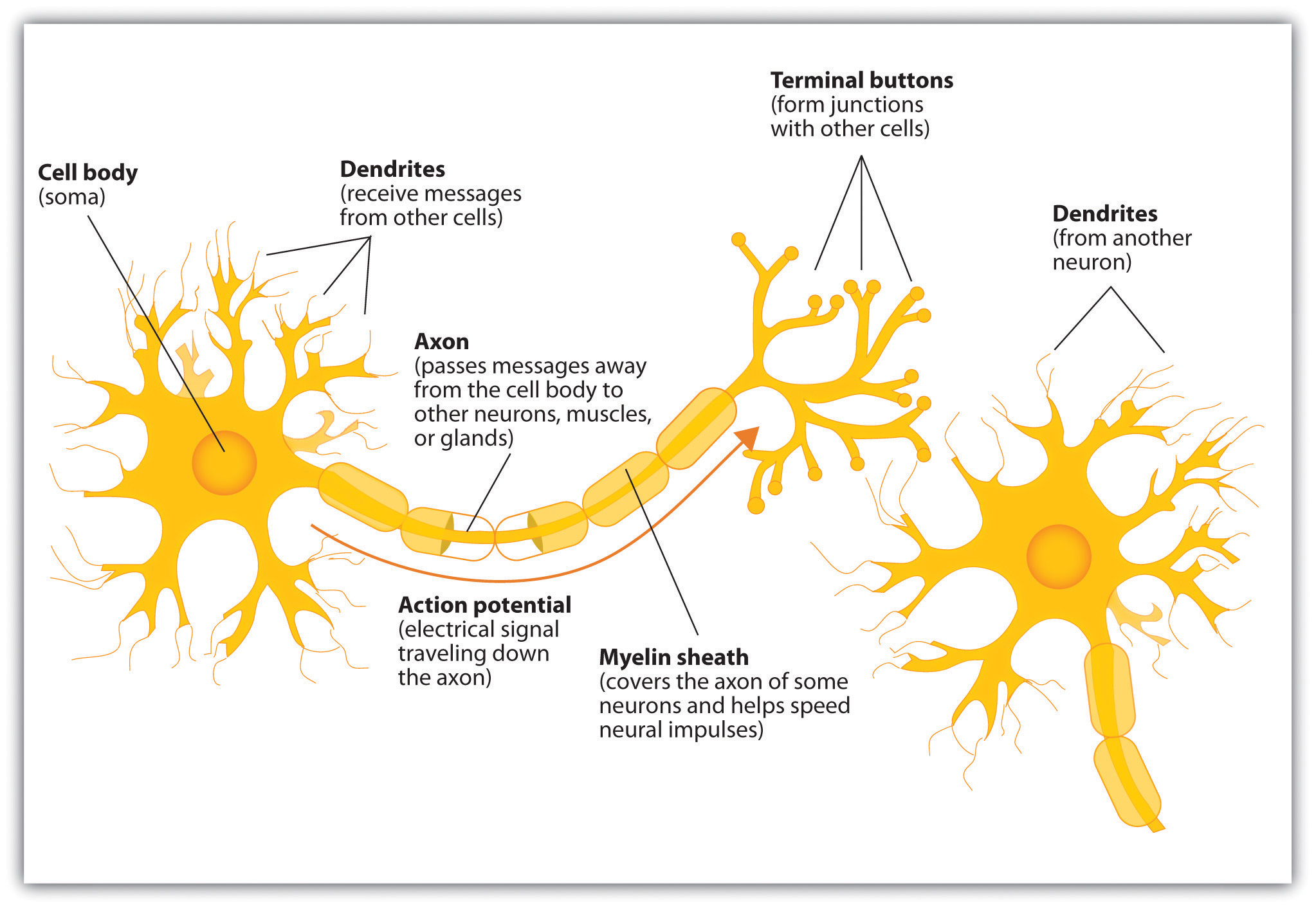
a structure that permits a neuron to pass a chemical or electrical signal to another cell
How Does a Neuron Fire?
-Resting Potential: slightly negative charge
-reaches the threshold when enough neurotransmitters reach dendrites
-It is an electrochemical process: electrical inside the neuron and chemical outside the neuron (in the synapse in the form of a neurotransmitter)
-The firing is called Action Potential
The All-or-None Response
-the idea that either the neuron fires or it doesn't; no part-way firing
Neurotransmitters
 -chemical messengers releases by terminal buttons through the synapse
We should know at least 4 types and what they do
- Acetylchlorine (ACH)
- deals with motor movement and memory
- lack of ACH is linked to Alzheimer's Disease
- Dopamine
- deals with motor movement and alertness
- lack of dopamine linked to Parkinson's Disease
- too much dopamine has been linked to schizophrenia
- Serotonin
- involved in mood control
- lack of serotonin has been linked to clinical depression
- Endorphins
- involved in pain control
- many addictive drugs deal with endorphins
-Agonists: make neurons fire
-Antagonists: stop neural firing
Three Types of Neurons
- Sensory Neurons (Afferent Neurons)
- take info from the senses to the brain
- Inter Neuron
- take messages from the sensory neurons to the other parts of the brain or to the motor neurons
- Motor (Efferent) Neurons
- take information from the brain to the rest of the body
-Central: brain and spinal cord
-Peripheral: all nerves not encased in bone; everything else that's not the brain or spinal cord
-Two Types:
- Somatic: controls voluntary muscle movement
- uses motor or efferent neurons
- Automatic: controls automatic functions of the body
- sympathetic: fight or flight response
- automatically accelerates heart rate, breathing, dilates pupils, slows down digestion
- parasympathetic: automatically slows down after a stressful event
- heart rate and breathing slow down, pupils constrict, and digestion speeds up
-normally, sensory (afferent) neurons take info up through spine to the brain
-some reactions occur when sensory neurons reach just the spinal cord, doesn't need to go to the brain
Ways to Study the Brain
-Lesions: cutting into the brain and looking for change
-EEG
CAT scan
Brain Structures
- Hindbrain
- Medulla Oblongata: in charge of heart rate, breathing, and blood pressure
- Pons: connects hindbrain, mindbrain, and forebrain together
- involved in facial expressions
- Cerebellum: located in the back of the head.
- "Little Brain"
- coordinates muscle movements
- like tracking a target
- Midbrain: coordinates simple movements with sensory information. Contains reticular information: arousal and ability to focus attention
- Forebrain
- Thalamus: receives sensory information and sends them to appropriate areas of forebrain
- like a switchboard
- covers all senses except smell
- Hypothalamus
- pea sized
- responsible for body temperature, hunger, thirst, sexual arousal (libido)
- Hippocampus and Amygdala
- hippocampus is involved in memory processing
- amygdala is vital for our basic emotions
- Cerebral Cortex
- top layer of our brain
- contains wrinkles called fissures, which increases surface area of our brain
- laid out, it would be about the size of a large pizza
- Lefties: better at spatial and creative tasks
- Righties: are better at logic
-when removed, you have a split-brain

No comments:
Post a Comment